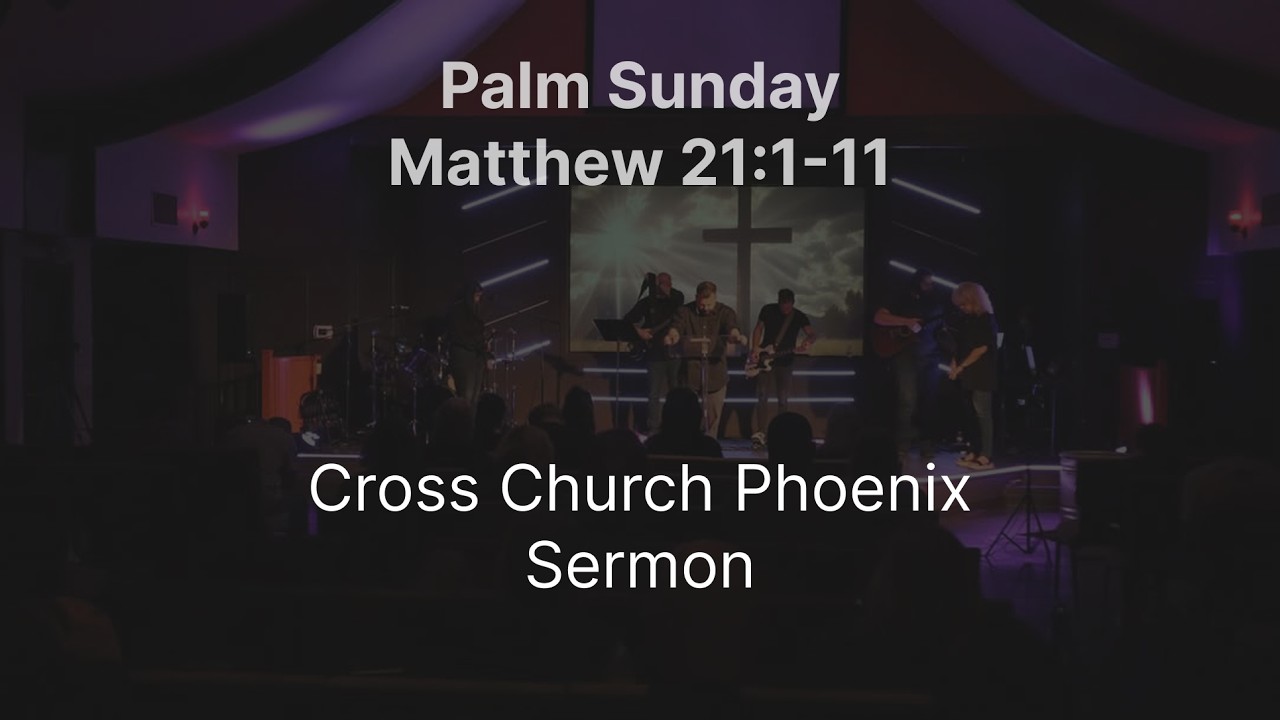
Palm Sunday
This Palm Sunday, we explore the significance of Jesus' triumphal entry into Jerusalem as a powerful revelation of His identity as Lord. We begin by recognizing the context of this event within our ongoing discipleship journey, emphasizing our mission to fulfill the Great Commission. As we read from Matthew 21:1-11, we see Jesus humbly riding on a donkey, fulfilling Old Testament prophecy and publicly declaring His kingship. This moment marks a shift in Jesus' ministry, as He transitions from a time of relative secrecy to a public acknowledgment of His divine authority.
We discover that Jesus is revealed as Lord through His omniscience, prophetic fulfillment, and the praise He receives. The crowds shout "Hosanna!" and recognize Him as the Son of David, while the religious leaders struggle to see Him for who He truly is. This raises the crucial question for all of us: Who is Jesus? We are challenged to confront our understanding of Him, not as a version we create for ourselves, but as the King of Kings and Lord of Lords. Ultimately, we are invited to reflect on our own response to Jesus and consider whether we are ready to submit to His lordship in our lives.
Key Takeaways
- Jesus' triumphal entry into Jerusalem fulfills Old Testament prophecy, revealing Him as the King of Kings and Lord of Lords.
- The crowds recognized Jesus' authority, shouting praises that were reserved for God, while the religious leaders failed to see Him for who He truly is.
- Our understanding of Jesus must be grounded in who He is objectively, not in our personal interpretations or desires.
- Jesus' entry on a donkey symbolizes His mission of peace, contrasting with the expectations of a political savior.
- The question for us is not who Jesus is to us, but who He is in truth, challenging us to respond to His lordship in our lives.
Scripture References
Discussion Questions
- What does Jesus' entry into Jerusalem teach us about humility and authority?
- How can we better understand the significance of Jesus fulfilling Old Testament prophecies?
- In what ways do we sometimes create a version of Jesus that fits our expectations rather than accepting Him for who He is?
- How can we respond to the question 'Who is Jesus?' in our daily lives?
- What does it mean for us to submit to Jesus as Lord, and how can we encourage others to do the same?
Transcript
· Amen. Amen. Welcome uh to Crossurch Phoenix. I'm Pastor DJ. And if I haven't met you before, welcome. Uh come find me afterwards. I'd love to meet you, hang out with you, um and get to know you more. Um at this time, let's open our Bibles to Matthew chap 21, beginning there at verse one. And if you don't have a Bible, we have some in the seat back in front of you. If you that is our gift to you. you can have it. You can highlight it, underline it, make notes, whatever um helps you and bring it back next week. Um but that is your Bible if you need one.
· Well, again, I want to say if you're new with us, welcome. Uh we are uh this morning we are closing out our sermon series, launching our 2-year disciplehip journey called Let's Go.
· And I know I've been kind of on repeat over the past few weeks, but um just kind of emphasizing what this is and we live in a day when many churches across America are closing. And so let's go um is cross church's response to that. Um our theme has been over the past several weeks fulfilling the great commission one church at a time. Our mission here is to make Jesus known by creating a movement of multiplying churches that are biblical, relevant, and missional. And so, I'm excited to see what God does in and through our church here at Phoenix and across the collective as we engage with Let's Go.
· So, as you can see, there's some commitment cards and more Easter invitations in the chairs around you.
· Um, I I encourage you to take an Easter invite. Maybe you already have a few.
· Um, you could take some more if you'd like and and pass them out. Invite folks to um Good Friday and uh Easter, but also you'll see um the the commitment card. So, if you don't have a card or maybe you forgot it or your dog ate it, you know, I don't know. Um you know, like your homework or something, um there's extras there for you. Um but this morning is special for two reasons, obviously. Number one, it's Palm Sunday.
· Yeah.
· Amen. The day that our Lord Jesus Christ humbly rode into Jerusalem on a donkey. And we'll get to that.
· But second, of course, it is our commitment Sunday. And so towards the end of the service, we'll spend a few moments dedicating our engagement with Let's Go to the Lord. Um, and that's what these are for. If you're wondering, what are the buckets for? Yeah, we'll get to that. All I want is for you to have a card. I don't want you to do anything with it yet, okay? So, just I don't want us to be distracted. Let's I just want you to have it. Don't do anything with it right now. Um we will go to God's word first. And if you're able, I invite you to stand as we read God's word together. Um and if you can't or that's, you know, it's difficult, you stand with us in spirit. Um but um you're invited to do that as we read Matthew 21:es 1-11 and it reads this way.
· When they approached Jerusalem and came to Beth Page at the Mount of Olives, Jesus then sent two disciples telling them go into the village ahead of you.
· At once you will find a donkey tied there with her fo. Untie them and bring them to me. If anyone says anything to you, say that the Lord needs them, and he will send them at once. This took place so that what was spoken through the prophet might be fulfilled. Tell daughter Zion, "See, your king is coming to you gentle and mounted on a donkey and on a colt the full of a donkey."
· The disciples went and did just as Jesus directed them. They brought the donkey and its full. and they laid their clothes on them and he sat on them. A very large crowd spread their clothes on the road and others were cutting branches from the trees and spreading them on the road. Then the crowds who went ahead of him and those who followed shouted, "Hosana to the son of David, blessed is he who comes in the name of the Lord. Hosana in the highest heaven."
· Verse 10. When he entered Jerusalem, the whole city was in an uproar, saying, "Who is this?"
· The crowds were saying, "This is the prophet Jesus from Nazareth in Galilee." Thanks. You can be seated. Well, let's pray. Father, we thank you for this morning. I thank you for your word. I pray God that you would help us. Help us to see the truth of the word of God. Help us to see Jesus for who he is.
· Pray that you would give us eyes to see and ears to hear what the Holy Spirit has to say to the church at Cross Church Phoenix in Jesus name. Amen. Well, the Bible says that at the name of Jesus, every knee will bow in heaven, on earth, and under the earth, and every tongue will confess that Jesus Christ is Lord to the glory of God the Father.
· As Paul is discussing the humility of Jesus Christ in Philippians chapter 2, he joins it with the guarantee that one day every knee will bow, every tongue will confess that Jesus is Lord. It doesn't just say all Christians, all believers. It says everyone will bow the knee and confess that Jesus Christ is Lord. When Paul in Philippians 2 says, "Everyone in heaven, on earth, and under the earth is a Bible way of saying everyone."
· It doesn't really get more holistic than that. Everyone in heaven, everyone on earth, and everyone under the earth is a way of saying everyone. And it's emphatic for a reason because the truth is Jesus is Lord.
· None of us make him Lord. And I understand the sentiment when we make him like Lord of our lives. And I I get that. But I want us to understand something very clearly that um he is Lord whether whether we confess that or not. Right?
· Because it's not like we're in control as men and women as humanity that we're in control of whether or not Jesus is Lord. What the Bible teaches is that he is Lord. The real question is whether or not you and I submit to him as Lord or rebel against him as Lord. That's the question.
· The real question. Do we reject him as Lord or receive him as Lord? Either way, it doesn't change the fact that he is Lord.
· And that's what's going on at this point in Matthew chapter 21. Really, verse 10 kind of sums up the controversy surrounding the triumphal entry. Who is this?
· Who's the one making all that ruckus?
· Right? I shared with first service go a little off script, but it reminded me of the sand lot. You know, when the old guy comes out and he he meets the kids, he's like, "You guys are the one making all that ruckus, right? Who is this coming into Jerusalem and the whole city's in an uproar?
· Who is this?
· And so I've titled the sermon, if you have a handout, um you um they're in the back if you don't have one, but if you have one at the top, you'll see there the triumphant Lord of the Triumphal entry. Jesus triumphal entry into Jerusalem is Jesus publicly revealing himself as king of kings and lord of lords.
· And so if you have a handout that's the uh the main heading is the triumphant lord of the triumphal entry. And then our main point is Jesus revealed as lord. and we'll see different ways Jesus is revealed as Lord.
· To understand where we're going though with this and to kind of put the triumphal entry into um a bigger perspective, we need to understand some context in the overall story. You see, early in Jesus ministry, he would do miraculous healings and then do something very interesting. He would do a healing and then command the person that he just healed to don't tell anyone.
· And what we know from the scriptures and from the gospels is that some people couldn't help themselves and they would go spread the word anyway. But it doesn't change. Jesus would do a healing and say don't tell anyone. Why? Fascinating, right? For example, in Matthew 8, Jesus heals a leper who had come to him. And in Matthew 8:4, we read this. And Jesus said to him, "See that you say nothing to anyone."
· Interesting, right? And that's not the only time he does it in reference even to a healing. In Matthew chapter 16 would be another example. Jesus is hanging out with his disciples and they and he asked them, "Who do the people say that I am?" And of course, they respond, "Well, you know, Jesus, well, some say that you're John the Baptist, like reincarnated." Um, others are saying that you're Elijah. Some are saying you're Jeremiah, one of the prophets. And he says, okay, who do you say? He looks at his disciples. Who do you say that I am? And Peter responds and makes this glorious confession, right? What does he say? You are the Christ, the son of the living God, Jesus.
· And Jesus says, right? Ding, ding, ding. You got it right. Good job. Thumbs up. Two thumbs up for Peter. Right. You're right, Peter. And in Matthew 16:20, we read something very curious. It says this, "Then he, Jesus, strictly charged the disciples to tell no one that he was the Christ."
· What?
· What? Come on, Jesus. Like, we're supposed to spread of Yes. And we've been in the great commission for a while. So, we know that he is going to command him to go be made known to the ends of the earth. Of course. But it's fascinating that up until this point, Jesus has wanted his identity to be somewhat hidden.
· Matthew 16:20, Jesus charged the disciples to tell no one he was the Christ. What does the very next verse say? Verse 21 of Matthew 16, it says, "From that time Jesus began to show his disciples that he must go to Jerusalem and suffer many things from the elders and chief priests and scribes and be killed and on the third day be raised predicting his entry into Jerusalem, his arrest, death, burial, and resurrection." Guys, this is what's going to happen.
· And here we are. Uh that brings us to Matthew 21. Jesus is now entering into Jerusalem. And so you ask a question, okay, why does Jesus tell the disciples or the healed lepers not to say anything or reveal who he is at those moments in time? And the simple answer would be that it wasn't yet his time.
· Everything everything. Did I mention everything is on divine schedule, including Jesus triumphal entry into Jerusalem? And I don't have time to camp here very long. This could be a sermon in of itself. But Daniel prophesies Christ's entry into Jerusalem specifically to the day. You could do the research yourself. Yeah, we'll talk about it later, but he predicts it to Passover 32 AD when Christ enters. You could take it to the bank, but that's a different sermon.
· Um, but what you need to know is that everything is on a divine schedule, including his triumphal entry into Jerusalem. It couldn't have been the week before. It couldn't have been the week after. It's now.
· It's right now.
· You see, Jesus spent most of his ministry in northern Israel in a region called Galilee. And in Matthew 19, we see this shift where Jesus leaves Galilee heading journeying toward Jerusalem. And he's teaching along the way. This is a long journey down to the south toward Jerusalem. He's teaching along the way doing it's wonderful. It's just great, right? But we get to chapter 20 29 and when you get to chapter 20, there is a shift.
· A theme presents itself that has been different from what has been going on all of Matthew. This is very important. A theme begins in 20 29 continuing into 21 where Jesus is no longer telling anyone to be quiet about who he is. Rather, it's time to go public. And he no longer tells anyone to be quiet, but to cry out. Cry out. And that's the theme. There's intentional use of this.
· It is time to go public. There's a clear theme that Matthew is communicating which is crying out publicly to the Lord. Okay? Jesus is being revealed as Lord. And in the process, if you can kind of picture it in your mind, things, if I could say put it this way, things are getting loud. Now, in Matthew's narrative, that's kind of how he's presenting this, he will describe different people crying out to the Lord or shouting, some translations will put it, but crying out and shouting are the same Greek word.
· It's just how translators want to put it. This all begins in verse 2029. If you'll look there, two blind men are crying out to Jesus. They're calling out to him, calling him Lord and the son of David. Now, this is key. The crowd what? Wanted them to be quiet.
· And Jesus here is no longer telling anyone to be quiet about him. The crowd said, "Be quiet." But what does it say?
· It says, "But they cried out all the more to him, Lord, have mercy on us, on me, son of David." And instead of stopping them, Jesus calls them, heals them, and they join the entourage. So picture it. Two recently, within minutes or hours, recently healed blind men are part of this crew coming into Jerusalem with Jesus.
· And in our text and after it, we will see this theme continue. Jesus is being publicly revealed as the King of Kings and the Lord of Lords. And people are shouting and crying out to him. So here's what I want us to see. How Jesus is revealed as Lord. The first thing we see, and this is in your notes, Jesus is revealed as Lord by his omniscience. uh by his omniscience.
· We see this in verse two and three respectively. You see, you will find and he will send. Jesus is predicting the future. And this isn't the first time he's done it. He predicted what? In Matthew 16, after Peter confessed that he is the Christ, the son of the living God, Jesus says, "Yep, and we're going to go to Jerusalem and I'm going to be turned over to I'm going to suffer many things, die, and rise again."
· This is just another prediction of the future. He says, "Go to the village ahead of you. You will future, right?
· You will find a donkey tied with her colt. Untie them. Bring them to me. If anyone says anything to you, just tell them you know the Lord has need of it and he will write another future. He will send them. So these you wills and he wills are what's called future indicatives. It's a fancy way of saying in in a in a Greek parsing that it's indicating the future. That's what he's doing. Jesus is simply saying this is what will happen.
· Jesus knows the future and everything is on divine schedule. Which leads me to my next point. Number two, Jesus re is revealed as Lord by prophetic fulfillment. Prophetic fulfillment.
· Jesus is predicting the future to fulfill the past. Isn't that cool?
· He's telling them what's about to happen because it's going to fulfill something that was said five approximately 500 years before.
· Jesus isn't telling the disciples to get him the donkey to ride into Jerusalem because he's tired of walking where they came from from Matthew 16 from Cesaria Philippi. The journey from Cesaria Philippi to a mile or so outside of Jerusalem is about a hundred miles that Jesus had already walked. He didn't Uber to Jerusalem, right? Um he had already walked, we could say like 97 or 98 miles. Okay. He's not asking for a donkey or telling them to go retrieve this because he's tired.
· He's doing it to fulfill prophecy written hundreds of years before in Zechariah 9:9. And Matthew wants us to know that, right? People ask us, "How can we trust the Bible?" Well, fulfillment of prophecy is one way. There's a lot of evidences and ways that we could trust scripture, but Zechariah 9:9 was written almost 500 years before Christ was born in Bethlehem as the babe, as the incarnate son of God.
· And so, we have him riding a donkey into Jerusalem. And the scripture says, "Behold, your king, right, comes." and he's fulfilling this passage intentionally. This is a deliberate move to fulfill prophecy. Jesus isn't going to let any prophetic statement of him in the Old Testament go unfulfilled in the New. He's not like, "Well, you know, I'm actually I'm good. I think I'll just walk the rest of the way." No, no, no.
· It's stop.
· Stop.
· Hey, you two disciples, whoever they were, go down. You're going to find this. bring him here. I'll I'll be here waiting. Why? To fulfill prophecy. We could speak more to prophetic fulfillment, but that's a different sermon. Um, but here Matthew was saying, look, Christ entered Jerusalem in a humble way, mounted on a donkey to fulfill prophecy.
· That's the point.
· And him coming on a donkey shows that he's coming to bring peace and not war. A king coming for war would come on what? A war horse. You know that kings going to war didn't ride in on a donkey.
· It' be kind of weird, right?
· Jesus, King Jesus came on a donkey the first time.
· the first time.
· When Jesus returns the second time, is he riding a donkey? No. Revelation 19 describes him coming on a white horse to do what? John tells us in Revelation 2, he comes riding on a white horse to judge and make war. And it says on his robe and on his thigh he has a name written king of kings and lord of lords.
· And he comes to wage final war against sin, wickedness, and evil and be triumphant over it. But here in Matthew 21, Jesus enters in humility. Why? Because he's coming to make peace. Let me tell you, Jesus didn't come to make war with Rome on behalf of the Jews. He came to make peace with God on behalf of sinful men.
· Big difference.
· They wanted what did the Jewish people want? They want a political regime change. They want Rome overthrown so that Israel can be their own nation again and they can be out of Roman occupancy. And Jesus does not come to do that. He comes to pay for their sin on the cross.
· That's what he's coming to do. To bring salvation. to go to the cross for our sin. He's the Lord of the universe. The same Jesus in Matthew 21 is the same Jesus in Revelation 19. Let's not separate those. It's Jesus. And he comes in humility going to a cross. We sang on a cross they made for sinners. Yeah. He who knew no sin became a sin offering for us is what the Bible says.
· Taking your sin and my sin upon himself. And so finally we see this Jesus is revealed as Lord by receiving praise revealed or res I'm sorry uh by receiving praise reserved only for God.
· And this is where the theme of crying out and shouting to the Lord comes back into play in Matthew's narrative. So they spread their clothes. They cut branches from trees. And the way we know it's palm branches is because John in John's gospel says they were palms. So thank you John. They're palms. And they then they begin to shout, right? Hosana to the son of David. Blessed is he who comes in the name of what? The Lord.
· Hosana in the highest heaven. And hosana simply means save now. Right? Save us now Jesus. Here comes the savior, the lord, the king. Save us now. And the word shouted there that what the crowds are doing is the same word used for the lepers crying out to Jesus for mercy. It's the same thing.
· So the whole city's in an uproar and the Greek word for uproar there is where we get our English word seismic. Um it's seo but we get our word uh derived from English seismic. He's trying to say like it's crazy right now in Jerusalem. The whole n the whole city is in an uproar. It's seismic. It's being shaken so to speak by the entry of Jesus into Jerusalem. You got to remember it's Passover week.
· So Jesus is doing this on purpose because Jerusalem would be heavily populated at this time. Probably the most populated time of the year at all kinds of people would go to Jerusalem for Passover week. We're talking like t a lot of people.
· And he's doing this on purpose. And things are stirring up. And no wonder they're saying, "Who is this?"
· And if you look down at verse 12, what's the first thing Jesus does after entering Jerusalem?
· He cleans the temple. Save us, Lord. Hosanna, save us, Lord. Save us. Jesus cleans the temple. Now, look down at verse 14 of of Matthew 21.
· The blind, the lame came to him and were healed. And what happens?
· Children are shouting.
· Same word for crying out. They're crying out, shouting whatever word you want to use to Jesus in the temple saying, "Hosana to the son of David." Same thing. And when they tell Jesus, shut these kids up, right? Jesus, do you hear what they're saying? Rabbi, quiet them. Shut them down.
· What does Jesus say? What is his response?
· Well, haven't you read?
· Have you not read?
· You have prepared praise from the mouths of infants and nursing babes. and he's quoting, that's Psalm 8:2. Jesus intentionally quotes a psalm for them, a psalm they should know. These are the chief priests and the elders and the scribes and the people who know the Old Testament the best.
· Haven't you read Psalm 8, guys?
· And by the way, how does Psalm 8 begin?
· Right? Jesus quotes verse two of Psalm 8, but what is verse one?
· Oh Lord, our Lord, how majestic is your name in all the earth. You have set your glory above the heavens. In thee, oh Lord, our Lord, there is, oh Yahweh, our Adonai, your name is majestic and praise will come from the mouths of babes children. And here it's happening. Now, Luke 19, you don't need to turn over there. Luke chapter 19 is the parallel passage for Matthew chap 21. And Luke adds an interesting detail on purpose.
· Luke describing Jesus triumphal entry says, "People are praising God joyfully with a loud voice." Okay. The Pharisees come to Jesus and they say basically the same thing they were telling him about the children. They say, "Teacher, rebuke your disciples." Translation, the DJ version, right? Translation, "Shut these people up.
· Shut them up, teacher, because they're giving you praise that is reserved only for God." When they are saying ble hosana to the son of David, blessed is he who comes in the name of the Lord. It's a quote from Psalm 118, all of which is praise reserved for Yahweh, for God. And Jesus is receiving it and he's not telling them to be quiet. So Luke says the Pharisees come to Jesus, "Teacher, rebuke your disciples.
· Shut these people up." Jesus response. I tell you, I tell you, if they were to keep silent, the stones would what? Cry out. They will cry out. If the if I stop this, the rocks will cry out to me.
· You say, "DJ, what's the point?" And by the way, Luke, the word he uses there is the same word in Matthew that Matthew's been using all along. You can trace that word all throughout. And it begins to take on a theme. What is the whole point? Well, that is this. Blind men see Jesus is Lord.
· children see Jesus is Lord. Who doesn't see Jesus is Lord? The Pharisees, the religious leaders, the ones who are supposed to know the Old Testament and to know and to recognize their King is here are the ones who won't cry out to him. The ones who know the scriptures the most don't see the truth standing in front of them.
· The bigger lesson that is getting across is blind men and children saw Jesus more clearly than the Pharisees.
· The triumphal entry is sandwiched between these stories about blind men crying out to him. He enters Jerusalem and children and other people who are being healed by him crying out to him and the theme and it comes together the juxtaposition the comparison is that the Pharisees don't they are the ones stop this and Jesus is like no because it's my time now is the hour now is my time to be revealed as the king of kings and the lord of lords The Yahweh of the Old Testament is here.
· Luke takes it a step further, right?
· Matthew just says, "Hey, um, yeah, children and blind men and others see Jesus for who they Luke takes it a step further and says that if these people stop that rocks would recognize who I am and shout and cry out to me before the Pharisees.
· What is he saying?
· Have you ever heard the sign like dumber than a box of rocks or something like that? Right? like just see this guy's up or a bag of hammers rises up. Jesus is saying that a rock would do what it ought to do in the presence of God before a self-righteous Pharisee would. So, not only lepers and and blind men and children, a rock would do what they refuse to do. That's the point.
· So our closing question is this.
· The question confronting all of humanity um is is right there in verse 10, right?
· It's not who is Jesus to you. I'll explain this, but simply who is Jesus?
· What I mean by who is Jesus? It's not who is Jesus to you. It's not we don't come to Jesus a version of Jesus that we get to make up ourselves. Well, who is Jesus to you? Well, he's just a really good teacher, a nice guy, a rabbi, but you know, he wasn't God. He's not Yahweh. He's not.
· The question is objectively, who is Jesus? Because he is king of kings and lord of lords, but Pharisees reject that. Who is Jesus to them? A teacher and what? A blasphemer. Is that true? Well, he's a teacher. Yeah. Is he a blasphemer? No. It is who is Jesus question mark objectively. We don't get to make a Jesus of our own making.
· Conjure up the Jesus that we want. What is the Jesus that the Jewish people wanted and the religious leaders wanted?
· A savior not from sin. A savior from Roman oppression. And we don't come to Jesus for who we want him to be. We come to Jesus for who he is. I hope you could see the difference. That's what I'm trying to say. My hope and prayer is that you see Jesus for who he is as Lord.
· Not what you want him to be. not as a divine vending machine like Prosperity Gospel might be use for, but for who he is, King of Kings and Lord of Lords. So, I'm going to invite the worship team back up right now. Um, and we're going to just have some kind of light music in the background, but I want to invite you and and myself, preach to myself before I preach to you. All right? I want to invite you to reflect into a time of reflection.
· Do you need to cry out to the Lord for salvation this morning?
Part of Series

Let's Go!
View all episodesTranscript
· Amen. Amen. Welcome uh to Crossurch Phoenix. I'm Pastor DJ. And if I haven't met you before, welcome. Uh come find me afterwards. I'd love to meet you, hang out with you, um and get to know you more. Um at this time, let's open our Bibles to Matthew chap 21, beginning there at verse one. And if you don't have a Bible, we have some in the seat back in front of you. If you that is our gift to you. you can have it. You can highlight it, underline it, make notes, whatever um helps you and bring it back next week. Um but that is your Bible if you need one.
· Well, again, I want to say if you're new with us, welcome. Uh we are uh this morning we are closing out our sermon series, launching our 2-year disciplehip journey called Let's Go.
· And I know I've been kind of on repeat over the past few weeks, but um just kind of emphasizing what this is and we live in a day when many churches across America are closing. And so let's go um is cross church's response to that. Um our theme has been over the past several weeks fulfilling the great commission one church at a time. Our mission here is to make Jesus known by creating a movement of multiplying churches that are biblical, relevant, and missional. And so, I'm excited to see what God does in and through our church here at Phoenix and across the collective as we engage with Let's Go.
· So, as you can see, there's some commitment cards and more Easter invitations in the chairs around you.
· Um, I I encourage you to take an Easter invite. Maybe you already have a few.
· Um, you could take some more if you'd like and and pass them out. Invite folks to um Good Friday and uh Easter, but also you'll see um the the commitment card. So, if you don't have a card or maybe you forgot it or your dog ate it, you know, I don't know. Um you know, like your homework or something, um there's extras there for you. Um but this morning is special for two reasons, obviously. Number one, it's Palm Sunday.
· Yeah.
· Amen. The day that our Lord Jesus Christ humbly rode into Jerusalem on a donkey. And we'll get to that.
· But second, of course, it is our commitment Sunday. And so towards the end of the service, we'll spend a few moments dedicating our engagement with Let's Go to the Lord. Um, and that's what these are for. If you're wondering, what are the buckets for? Yeah, we'll get to that. All I want is for you to have a card. I don't want you to do anything with it yet, okay? So, just I don't want us to be distracted. Let's I just want you to have it. Don't do anything with it right now. Um we will go to God's word first. And if you're able, I invite you to stand as we read God's word together. Um and if you can't or that's, you know, it's difficult, you stand with us in spirit. Um but um you're invited to do that as we read Matthew 21:es 1-11 and it reads this way.
· When they approached Jerusalem and came to Beth Page at the Mount of Olives, Jesus then sent two disciples telling them go into the village ahead of you.
· At once you will find a donkey tied there with her fo. Untie them and bring them to me. If anyone says anything to you, say that the Lord needs them, and he will send them at once. This took place so that what was spoken through the prophet might be fulfilled. Tell daughter Zion, "See, your king is coming to you gentle and mounted on a donkey and on a colt the full of a donkey."
· The disciples went and did just as Jesus directed them. They brought the donkey and its full. and they laid their clothes on them and he sat on them. A very large crowd spread their clothes on the road and others were cutting branches from the trees and spreading them on the road. Then the crowds who went ahead of him and those who followed shouted, "Hosana to the son of David, blessed is he who comes in the name of the Lord. Hosana in the highest heaven."
· Verse 10. When he entered Jerusalem, the whole city was in an uproar, saying, "Who is this?"
· The crowds were saying, "This is the prophet Jesus from Nazareth in Galilee." Thanks. You can be seated. Well, let's pray. Father, we thank you for this morning. I thank you for your word. I pray God that you would help us. Help us to see the truth of the word of God. Help us to see Jesus for who he is.
· Pray that you would give us eyes to see and ears to hear what the Holy Spirit has to say to the church at Cross Church Phoenix in Jesus name. Amen. Well, the Bible says that at the name of Jesus, every knee will bow in heaven, on earth, and under the earth, and every tongue will confess that Jesus Christ is Lord to the glory of God the Father.
· As Paul is discussing the humility of Jesus Christ in Philippians chapter 2, he joins it with the guarantee that one day every knee will bow, every tongue will confess that Jesus is Lord. It doesn't just say all Christians, all believers. It says everyone will bow the knee and confess that Jesus Christ is Lord. When Paul in Philippians 2 says, "Everyone in heaven, on earth, and under the earth is a Bible way of saying everyone."
· It doesn't really get more holistic than that. Everyone in heaven, everyone on earth, and everyone under the earth is a way of saying everyone. And it's emphatic for a reason because the truth is Jesus is Lord.
· None of us make him Lord. And I understand the sentiment when we make him like Lord of our lives. And I I get that. But I want us to understand something very clearly that um he is Lord whether whether we confess that or not. Right?
· Because it's not like we're in control as men and women as humanity that we're in control of whether or not Jesus is Lord. What the Bible teaches is that he is Lord. The real question is whether or not you and I submit to him as Lord or rebel against him as Lord. That's the question.
· The real question. Do we reject him as Lord or receive him as Lord? Either way, it doesn't change the fact that he is Lord.
· And that's what's going on at this point in Matthew chapter 21. Really, verse 10 kind of sums up the controversy surrounding the triumphal entry. Who is this?
· Who's the one making all that ruckus?
· Right? I shared with first service go a little off script, but it reminded me of the sand lot. You know, when the old guy comes out and he he meets the kids, he's like, "You guys are the one making all that ruckus, right? Who is this coming into Jerusalem and the whole city's in an uproar?
· Who is this?
· And so I've titled the sermon, if you have a handout, um you um they're in the back if you don't have one, but if you have one at the top, you'll see there the triumphant Lord of the Triumphal entry. Jesus triumphal entry into Jerusalem is Jesus publicly revealing himself as king of kings and lord of lords.
· And so if you have a handout that's the uh the main heading is the triumphant lord of the triumphal entry. And then our main point is Jesus revealed as lord. and we'll see different ways Jesus is revealed as Lord.
· To understand where we're going though with this and to kind of put the triumphal entry into um a bigger perspective, we need to understand some context in the overall story. You see, early in Jesus ministry, he would do miraculous healings and then do something very interesting. He would do a healing and then command the person that he just healed to don't tell anyone.
· And what we know from the scriptures and from the gospels is that some people couldn't help themselves and they would go spread the word anyway. But it doesn't change. Jesus would do a healing and say don't tell anyone. Why? Fascinating, right? For example, in Matthew 8, Jesus heals a leper who had come to him. And in Matthew 8:4, we read this. And Jesus said to him, "See that you say nothing to anyone."
· Interesting, right? And that's not the only time he does it in reference even to a healing. In Matthew chapter 16 would be another example. Jesus is hanging out with his disciples and they and he asked them, "Who do the people say that I am?" And of course, they respond, "Well, you know, Jesus, well, some say that you're John the Baptist, like reincarnated." Um, others are saying that you're Elijah. Some are saying you're Jeremiah, one of the prophets. And he says, okay, who do you say? He looks at his disciples. Who do you say that I am? And Peter responds and makes this glorious confession, right? What does he say? You are the Christ, the son of the living God, Jesus.
· And Jesus says, right? Ding, ding, ding. You got it right. Good job. Thumbs up. Two thumbs up for Peter. Right. You're right, Peter. And in Matthew 16:20, we read something very curious. It says this, "Then he, Jesus, strictly charged the disciples to tell no one that he was the Christ."
· What?
· What? Come on, Jesus. Like, we're supposed to spread of Yes. And we've been in the great commission for a while. So, we know that he is going to command him to go be made known to the ends of the earth. Of course. But it's fascinating that up until this point, Jesus has wanted his identity to be somewhat hidden.
· Matthew 16:20, Jesus charged the disciples to tell no one he was the Christ. What does the very next verse say? Verse 21 of Matthew 16, it says, "From that time Jesus began to show his disciples that he must go to Jerusalem and suffer many things from the elders and chief priests and scribes and be killed and on the third day be raised predicting his entry into Jerusalem, his arrest, death, burial, and resurrection." Guys, this is what's going to happen.
· And here we are. Uh that brings us to Matthew 21. Jesus is now entering into Jerusalem. And so you ask a question, okay, why does Jesus tell the disciples or the healed lepers not to say anything or reveal who he is at those moments in time? And the simple answer would be that it wasn't yet his time.
· Everything everything. Did I mention everything is on divine schedule, including Jesus triumphal entry into Jerusalem? And I don't have time to camp here very long. This could be a sermon in of itself. But Daniel prophesies Christ's entry into Jerusalem specifically to the day. You could do the research yourself. Yeah, we'll talk about it later, but he predicts it to Passover 32 AD when Christ enters. You could take it to the bank, but that's a different sermon.
· Um, but what you need to know is that everything is on a divine schedule, including his triumphal entry into Jerusalem. It couldn't have been the week before. It couldn't have been the week after. It's now.
· It's right now.
· You see, Jesus spent most of his ministry in northern Israel in a region called Galilee. And in Matthew 19, we see this shift where Jesus leaves Galilee heading journeying toward Jerusalem. And he's teaching along the way. This is a long journey down to the south toward Jerusalem. He's teaching along the way doing it's wonderful. It's just great, right? But we get to chapter 20 29 and when you get to chapter 20, there is a shift.
· A theme presents itself that has been different from what has been going on all of Matthew. This is very important. A theme begins in 20 29 continuing into 21 where Jesus is no longer telling anyone to be quiet about who he is. Rather, it's time to go public. And he no longer tells anyone to be quiet, but to cry out. Cry out. And that's the theme. There's intentional use of this.
· It is time to go public. There's a clear theme that Matthew is communicating which is crying out publicly to the Lord. Okay? Jesus is being revealed as Lord. And in the process, if you can kind of picture it in your mind, things, if I could say put it this way, things are getting loud. Now, in Matthew's narrative, that's kind of how he's presenting this, he will describe different people crying out to the Lord or shouting, some translations will put it, but crying out and shouting are the same Greek word.
· It's just how translators want to put it. This all begins in verse 2029. If you'll look there, two blind men are crying out to Jesus. They're calling out to him, calling him Lord and the son of David. Now, this is key. The crowd what? Wanted them to be quiet.
· And Jesus here is no longer telling anyone to be quiet about him. The crowd said, "Be quiet." But what does it say?
· It says, "But they cried out all the more to him, Lord, have mercy on us, on me, son of David." And instead of stopping them, Jesus calls them, heals them, and they join the entourage. So picture it. Two recently, within minutes or hours, recently healed blind men are part of this crew coming into Jerusalem with Jesus.
· And in our text and after it, we will see this theme continue. Jesus is being publicly revealed as the King of Kings and the Lord of Lords. And people are shouting and crying out to him. So here's what I want us to see. How Jesus is revealed as Lord. The first thing we see, and this is in your notes, Jesus is revealed as Lord by his omniscience. uh by his omniscience.
· We see this in verse two and three respectively. You see, you will find and he will send. Jesus is predicting the future. And this isn't the first time he's done it. He predicted what? In Matthew 16, after Peter confessed that he is the Christ, the son of the living God, Jesus says, "Yep, and we're going to go to Jerusalem and I'm going to be turned over to I'm going to suffer many things, die, and rise again."
· This is just another prediction of the future. He says, "Go to the village ahead of you. You will future, right?
· You will find a donkey tied with her colt. Untie them. Bring them to me. If anyone says anything to you, just tell them you know the Lord has need of it and he will write another future. He will send them. So these you wills and he wills are what's called future indicatives. It's a fancy way of saying in in a in a Greek parsing that it's indicating the future. That's what he's doing. Jesus is simply saying this is what will happen.
· Jesus knows the future and everything is on divine schedule. Which leads me to my next point. Number two, Jesus re is revealed as Lord by prophetic fulfillment. Prophetic fulfillment.
· Jesus is predicting the future to fulfill the past. Isn't that cool?
· He's telling them what's about to happen because it's going to fulfill something that was said five approximately 500 years before.
· Jesus isn't telling the disciples to get him the donkey to ride into Jerusalem because he's tired of walking where they came from from Matthew 16 from Cesaria Philippi. The journey from Cesaria Philippi to a mile or so outside of Jerusalem is about a hundred miles that Jesus had already walked. He didn't Uber to Jerusalem, right? Um he had already walked, we could say like 97 or 98 miles. Okay. He's not asking for a donkey or telling them to go retrieve this because he's tired.
· He's doing it to fulfill prophecy written hundreds of years before in Zechariah 9:9. And Matthew wants us to know that, right? People ask us, "How can we trust the Bible?" Well, fulfillment of prophecy is one way. There's a lot of evidences and ways that we could trust scripture, but Zechariah 9:9 was written almost 500 years before Christ was born in Bethlehem as the babe, as the incarnate son of God.
· And so, we have him riding a donkey into Jerusalem. And the scripture says, "Behold, your king, right, comes." and he's fulfilling this passage intentionally. This is a deliberate move to fulfill prophecy. Jesus isn't going to let any prophetic statement of him in the Old Testament go unfulfilled in the New. He's not like, "Well, you know, I'm actually I'm good. I think I'll just walk the rest of the way." No, no, no.
· It's stop.
· Stop.
· Hey, you two disciples, whoever they were, go down. You're going to find this. bring him here. I'll I'll be here waiting. Why? To fulfill prophecy. We could speak more to prophetic fulfillment, but that's a different sermon. Um, but here Matthew was saying, look, Christ entered Jerusalem in a humble way, mounted on a donkey to fulfill prophecy.
· That's the point.
· And him coming on a donkey shows that he's coming to bring peace and not war. A king coming for war would come on what? A war horse. You know that kings going to war didn't ride in on a donkey.
· It' be kind of weird, right?
· Jesus, King Jesus came on a donkey the first time.
· the first time.
· When Jesus returns the second time, is he riding a donkey? No. Revelation 19 describes him coming on a white horse to do what? John tells us in Revelation 2, he comes riding on a white horse to judge and make war. And it says on his robe and on his thigh he has a name written king of kings and lord of lords.
· And he comes to wage final war against sin, wickedness, and evil and be triumphant over it. But here in Matthew 21, Jesus enters in humility. Why? Because he's coming to make peace. Let me tell you, Jesus didn't come to make war with Rome on behalf of the Jews. He came to make peace with God on behalf of sinful men.
· Big difference.
· They wanted what did the Jewish people want? They want a political regime change. They want Rome overthrown so that Israel can be their own nation again and they can be out of Roman occupancy. And Jesus does not come to do that. He comes to pay for their sin on the cross.
· That's what he's coming to do. To bring salvation. to go to the cross for our sin. He's the Lord of the universe. The same Jesus in Matthew 21 is the same Jesus in Revelation 19. Let's not separate those. It's Jesus. And he comes in humility going to a cross. We sang on a cross they made for sinners. Yeah. He who knew no sin became a sin offering for us is what the Bible says.
· Taking your sin and my sin upon himself. And so finally we see this Jesus is revealed as Lord by receiving praise revealed or res I'm sorry uh by receiving praise reserved only for God.
· And this is where the theme of crying out and shouting to the Lord comes back into play in Matthew's narrative. So they spread their clothes. They cut branches from trees. And the way we know it's palm branches is because John in John's gospel says they were palms. So thank you John. They're palms. And they then they begin to shout, right? Hosana to the son of David. Blessed is he who comes in the name of what? The Lord.
· Hosana in the highest heaven. And hosana simply means save now. Right? Save us now Jesus. Here comes the savior, the lord, the king. Save us now. And the word shouted there that what the crowds are doing is the same word used for the lepers crying out to Jesus for mercy. It's the same thing.
· So the whole city's in an uproar and the Greek word for uproar there is where we get our English word seismic. Um it's seo but we get our word uh derived from English seismic. He's trying to say like it's crazy right now in Jerusalem. The whole n the whole city is in an uproar. It's seismic. It's being shaken so to speak by the entry of Jesus into Jerusalem. You got to remember it's Passover week.
· So Jesus is doing this on purpose because Jerusalem would be heavily populated at this time. Probably the most populated time of the year at all kinds of people would go to Jerusalem for Passover week. We're talking like t a lot of people.
· And he's doing this on purpose. And things are stirring up. And no wonder they're saying, "Who is this?"
· And if you look down at verse 12, what's the first thing Jesus does after entering Jerusalem?
· He cleans the temple. Save us, Lord. Hosanna, save us, Lord. Save us. Jesus cleans the temple. Now, look down at verse 14 of of Matthew 21.
· The blind, the lame came to him and were healed. And what happens?
· Children are shouting.
· Same word for crying out. They're crying out, shouting whatever word you want to use to Jesus in the temple saying, "Hosana to the son of David." Same thing. And when they tell Jesus, shut these kids up, right? Jesus, do you hear what they're saying? Rabbi, quiet them. Shut them down.
· What does Jesus say? What is his response?
· Well, haven't you read?
· Have you not read?
· You have prepared praise from the mouths of infants and nursing babes. and he's quoting, that's Psalm 8:2. Jesus intentionally quotes a psalm for them, a psalm they should know. These are the chief priests and the elders and the scribes and the people who know the Old Testament the best.
· Haven't you read Psalm 8, guys?
· And by the way, how does Psalm 8 begin?
· Right? Jesus quotes verse two of Psalm 8, but what is verse one?
· Oh Lord, our Lord, how majestic is your name in all the earth. You have set your glory above the heavens. In thee, oh Lord, our Lord, there is, oh Yahweh, our Adonai, your name is majestic and praise will come from the mouths of babes children. And here it's happening. Now, Luke 19, you don't need to turn over there. Luke chapter 19 is the parallel passage for Matthew chap 21. And Luke adds an interesting detail on purpose.
· Luke describing Jesus triumphal entry says, "People are praising God joyfully with a loud voice." Okay. The Pharisees come to Jesus and they say basically the same thing they were telling him about the children. They say, "Teacher, rebuke your disciples." Translation, the DJ version, right? Translation, "Shut these people up.
· Shut them up, teacher, because they're giving you praise that is reserved only for God." When they are saying ble hosana to the son of David, blessed is he who comes in the name of the Lord. It's a quote from Psalm 118, all of which is praise reserved for Yahweh, for God. And Jesus is receiving it and he's not telling them to be quiet. So Luke says the Pharisees come to Jesus, "Teacher, rebuke your disciples.
· Shut these people up." Jesus response. I tell you, I tell you, if they were to keep silent, the stones would what? Cry out. They will cry out. If the if I stop this, the rocks will cry out to me.
· You say, "DJ, what's the point?" And by the way, Luke, the word he uses there is the same word in Matthew that Matthew's been using all along. You can trace that word all throughout. And it begins to take on a theme. What is the whole point? Well, that is this. Blind men see Jesus is Lord.
· children see Jesus is Lord. Who doesn't see Jesus is Lord? The Pharisees, the religious leaders, the ones who are supposed to know the Old Testament and to know and to recognize their King is here are the ones who won't cry out to him. The ones who know the scriptures the most don't see the truth standing in front of them.
· The bigger lesson that is getting across is blind men and children saw Jesus more clearly than the Pharisees.
· The triumphal entry is sandwiched between these stories about blind men crying out to him. He enters Jerusalem and children and other people who are being healed by him crying out to him and the theme and it comes together the juxtaposition the comparison is that the Pharisees don't they are the ones stop this and Jesus is like no because it's my time now is the hour now is my time to be revealed as the king of kings and the lord of lords The Yahweh of the Old Testament is here.
· Luke takes it a step further, right?
· Matthew just says, "Hey, um, yeah, children and blind men and others see Jesus for who they Luke takes it a step further and says that if these people stop that rocks would recognize who I am and shout and cry out to me before the Pharisees.
· What is he saying?
· Have you ever heard the sign like dumber than a box of rocks or something like that? Right? like just see this guy's up or a bag of hammers rises up. Jesus is saying that a rock would do what it ought to do in the presence of God before a self-righteous Pharisee would. So, not only lepers and and blind men and children, a rock would do what they refuse to do. That's the point.
· So our closing question is this.
· The question confronting all of humanity um is is right there in verse 10, right?
· It's not who is Jesus to you. I'll explain this, but simply who is Jesus?
· What I mean by who is Jesus? It's not who is Jesus to you. It's not we don't come to Jesus a version of Jesus that we get to make up ourselves. Well, who is Jesus to you? Well, he's just a really good teacher, a nice guy, a rabbi, but you know, he wasn't God. He's not Yahweh. He's not.
· The question is objectively, who is Jesus? Because he is king of kings and lord of lords, but Pharisees reject that. Who is Jesus to them? A teacher and what? A blasphemer. Is that true? Well, he's a teacher. Yeah. Is he a blasphemer? No. It is who is Jesus question mark objectively. We don't get to make a Jesus of our own making.
· Conjure up the Jesus that we want. What is the Jesus that the Jewish people wanted and the religious leaders wanted?
· A savior not from sin. A savior from Roman oppression. And we don't come to Jesus for who we want him to be. We come to Jesus for who he is. I hope you could see the difference. That's what I'm trying to say. My hope and prayer is that you see Jesus for who he is as Lord.
· Not what you want him to be. not as a divine vending machine like Prosperity Gospel might be use for, but for who he is, King of Kings and Lord of Lords. So, I'm going to invite the worship team back up right now. Um, and we're going to just have some kind of light music in the background, but I want to invite you and and myself, preach to myself before I preach to you. All right? I want to invite you to reflect into a time of reflection.
· Do you need to cry out to the Lord for salvation this morning?

Let's Go!